
A Record Surge, With Two Different Measures of Progress
Vietnam had registered $54.85 billion in foreign investment by October 31, 2026, a 74% rise from a year earlier and the strongest growth since 2009, the National Statistics Office under the Ministry of Finance said. The total includes money pledged for new projects, expansions at existing businesses and investments in company shares.
目录
- A Record Surge, With Two Different Measures of Progress
- What makes up the October total?
- Factories remain central, with logistics gaining attention
- Where is the money coming from?
- Ho Chi Minh City sets a $22 billion target
- Fast economic growth brings a complicated picture
- Will foreign investment reach local businesses?
- What comes next for the investment pipeline?
- Key Points
Money actually put into projects grew more slowly. Disbursed foreign direct investment, or FDI, reached $24.08 billion in the first 10 months, up 13.1% and the highest total for that period in five years. Registered capital records commitments; disbursement tracks investment implemented. The measures describe different stages of investment, so a surge in pledges does not mean the same amount has already gone into factories and other operations.
The gap between fast growing commitments and slower disbursement puts the focus on whether investors can carry out their plans, and how much local businesses gain from them. Vietnam's October figures were the latest step in a climb that had already brought registered FDI to $50.36 billion by September 30, up 76.4% from a year earlier.
What makes up the October total?
New projects accounted for $30.73 billion, registered across 3,478 projects. The amount was up 118.4% from a year earlier, while the number of projects rose 4.7%. Dividing the new capital by the project count gives an average of about $8.83 million per project, nearly double the previous year's average.
Existing investors registered another $16.13 billion for projects already operating in Vietnam, a 33.2% increase. Capital contributions and share purchases made up the remaining $7.99 billion, up 49.6%. In simple terms, the total combines plans to start projects, plans to expand businesses and purchases of stakes in companies.
That last category does not always put new money into a company's production. Of the 2,616 share and capital transactions, 1,788 transactions worth $4.71 billion did not increase the companies' charter capital, the registered capital used to establish or fund a business. They largely involved ownership changes. Such transactions can bring new management, markets or technology, while having a different direct effect on production capacity from building a new factory.
October investment surge had already drawn attention to the difference between commitments and spending. The new figures show that both continued to rise, although registered capital increased much faster.
Factories remain central, with logistics gaining attention
Manufacturing and processing attracted $25.2 billion in registered investment, or 45.9% of the national total. That makes production the largest destination, while transport, storage, science and technology, power and communications also feature among sectors receiving investment.
The September figures provide a closer look at new commitments. Between January and September, manufacturing and processing received $13.38 billion in newly registered capital, or 45.8% of the new project total. Transport and storage followed with $5.14 billion, or 17.6%. Across new projects and expansions together, manufacturing drew $21.82 billion, just over half of the combined amount.
The distinction between promises and deployment is visible in the sector mix. Manufacturing took 45.9% of registered FDI through October, while factories and processing plants accounted for 82.9% of the $24.08 billion disbursed during the same period. Existing production is therefore a major destination for money already being spent, even as new commitments extend into logistics and other fields.
Where is the money coming from?
Singapore led the sources of registered FDI through October, with $13.46 billion. South Korea contributed $10 billion, followed by Hong Kong with $6.75 billion, China with $5.04 billion and Luxembourg with $4.99 billion. The figures include the overall investment total, rather than only newly registered projects.
For new project capital in the first nine months, Singapore was also the largest source, with $9.26 billion. South Korea supplied $5.70 billion, Luxembourg $4.99 billion, China $2.27 billion and Japan $1.56 billion. That period's figures counted 79 investing countries and territories.
Vietnam's economic links with China were also in focus at the APEC meetings in Shenzhen. On November 17, Vietnamese and Chinese leaders discussed cooperation in supply chains, technology and transport. Hong Kong and the Chinese mainland together accounted for $6.34 billion, about one fifth of newly registered FDI in January through October; Hong Kong alone contributed $3.57 billion in that category.
The talks included plans for closer work on artificial intelligence, semiconductors, robotics and skills training. Sixteen memoranda of understanding were exchanged, and four joint research projects were announced, covering artificial intelligence in traditional medicine, water security, transport infrastructure monitoring and service robots for hospitals.
Ho Chi Minh City sets a $22 billion target
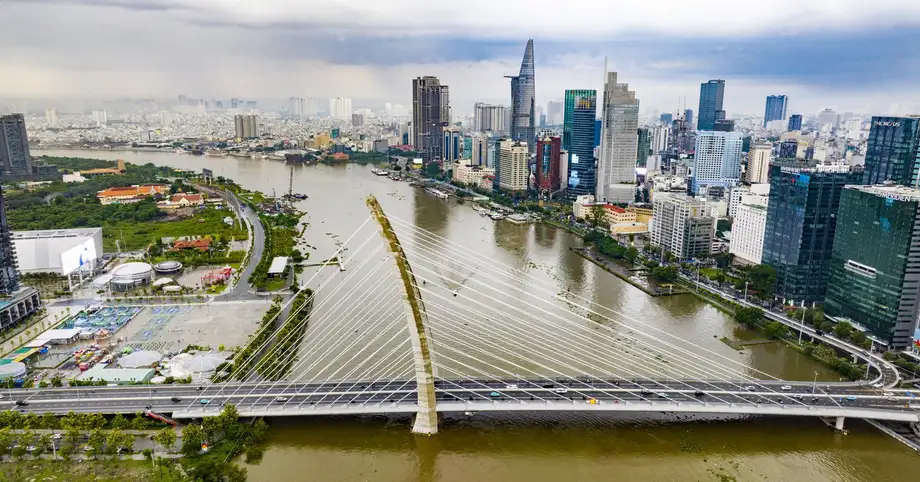
Ho Chi Minh City is seeking $22 billion in registered FDI for 2026, double its original target. The city's Department of Finance put investment through October at $19.13 billion, nearly 316% higher than a year earlier and close to 87% of the revised target.
A separate national breakdown for the same 10 month period listed Ho Chi Minh City at $20.14 billion, or 36.72% of the national total. The two figures are different, and no explanation for the gap was given. That breakdown put Thai Nguyen province second, with $8 billion; the two leading areas together accounted for 51.33% of national registered investment.
Ho Chi Minh City has more than 22,000 active foreign investment projects with registered capital exceeding $157.4 billion. Its priorities include high technology, digital infrastructure, logistics and green manufacturing, with authorities also seeking projects that connect to Vietnamese suppliers.
Major projects include the $4.9 billion Can Gio International Transshipment Port and Saigon Sports City, whose investment was adjusted to about $818 million. The city says it is tracking procedures and disbursement for major projects closely and working to address obstacles involving planning, land clearance and compensation. Travis Mitchell, executive director of the American Chamber of Commerce in Vietnam, said recent policy reforms had encouraged US businesses, particularly in semiconductors and high technology, energy and healthcare.
Recent policy reforms in Vietnam had provided strong encouragement for US businesses, particularly in semiconductors and high technology, energy and healthcare.
Fast economic growth brings a complicated picture
Vietnam's gross domestic product grew an estimated 9.01% in the first nine months of 2026, compared with 7.80% in the same period a year earlier. Growth rose from 8.15% in the first quarter to 9.95% in the third quarter. Industry and construction expanded 11.21%, services grew 8.69%, and agriculture, forestry and fisheries rose 4.02%.
Total social investment, which includes public and private spending in the economy, reached an estimated 3,109.6 trillion dong, or about $119.59 billion, in the first nine months. That was up 15.1%. Goods exports and imports together reached $888.02 billion, up 30.4%, but imports rose faster than exports. The nine month trade balance was a $19.42 billion deficit, compared with a $16.87 billion surplus a year earlier.
These figures show why investment is important to Vietnam's expansion, while also showing that growth comes with pressures. Consumer prices rose an average of 4.52% in the first nine months, above the government's target of about 4.5%. The National Statistics Office estimated international visitors at 17.7 million, about 71% of the 25 million target for the year.
Will foreign investment reach local businesses?
A large inflow of foreign capital does not automatically mean that Vietnamese suppliers win more orders or gain new skills. Dr. Nguyen Bich Lam, a former director general of the General Statistics Office, has argued that registered FDI should be separated from investment that creates new production capacity. He has also pointed to limited spillovers, meaning the ways foreign investment can transfer technology, expertise and business opportunities to local firms.
Economica Vietnam director Le Duy Binh has said that only about 5,000 of Vietnam's more than one million active businesses connect directly with global supply chains or multinational companies. About 100 Vietnamese firms are direct first tier suppliers to international companies. Those numbers show how few domestic firms currently occupy the position of supplying major companies directly.
Local businesses often need to meet strict requirements for quality, technology, delivery, finance and management before they can become suppliers. Stronger links could help foreign investment support more Vietnamese jobs and capabilities, but building those connections takes work from both investors and local firms. The Finance Ministry's Foreign Investment Agency has called for support through the full life of a project, from preparation and licensing to construction and operation.
The pace of actual investment matters as well. At the end of September, disbursed FDI stood at $21.07 billion, up 12.1% and the highest nine month amount in five years. The October total of $24.08 billion continued that rise. Vu Viet Linh of Maybank Investment Bank Vietnam has said realised FDI is a more reliable way to judge investment performance than newly registered capital, which represents commitments. Over the past decade, realised FDI grew by about 15% a year and the foreign investment sector accounted for roughly 20% of total social investment and nearly 25% of GDP.
What comes next for the investment pipeline?
Vietnam's next test is turning signed commitments into operating projects while making it easier for domestic firms to take part. The October figures show a record pace of registered investment and continued growth in spending, but those measures move at different speeds. Project approvals, land preparation, infrastructure and supplier readiness all affect when a commitment becomes production.
The city investment push and the November technology discussions point to a broader range of aims than attracting factories alone: better logistics, research, digital systems and trained workers. Vietnam's ability to deliver those conditions will shape whether new investment brings more than capital and export production.
Key Points
Registered FDI reached $54.85 billion through October 31, up 74% and the strongest growth since 2009.
Disbursed FDI totaled $24.08 billion, up 13.1% and the highest first 10 month figure in five years.
New projects accounted for $30.73 billion, expansions $16.13 billion and capital contributions or share purchases $7.99 billion.
Manufacturing and processing attracted $25.2 billion, or 45.9% of registered investment.
Ho Chi Minh City set a $22 billion target for the year as Vietnam seeks to connect foreign investors with more local businesses.