
A Historic Ring at the Nasdaq MarketSite
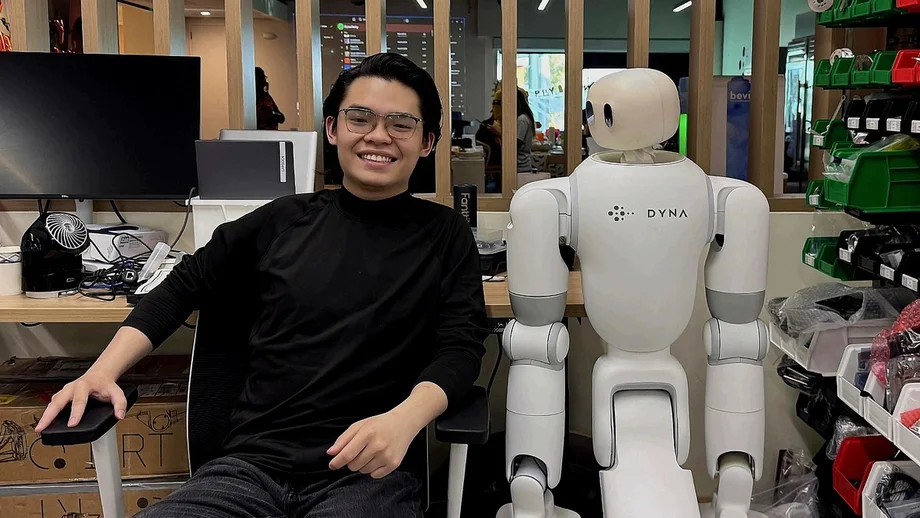
Pham Anh Quan stood inside the Silicon Valley headquarters of Dyna Robotics on October 13, 2026, watching a live broadcast from Times Square in New York. A semi-humanoid robot named Taku had just rung the closing bell at the Nasdaq MarketSite, marking the first time any robotic system participated in the high-profile financial tradition. The ceremony closed the Robotics Founders Forum of RoboStrategy, highlighting how artificial intelligence and physical automation are bridging the gap between digital research and everyday commerce. For Quan, a 23-year-old research scientist at the company, seeing the milestone unfold brought a deep sense of validation. As one of the few researchers who helped build the underlying algorithms that allow Taku to operate independently, Quan felt immense pride in watching the machine succeed on a global stage.
目录
Standing roughly as tall as an average adult, Taku does not resemble the bipedal humanoids often shown dancing or performing stunts in promotional videos. Dyna Robotics designed the machine with four steerable wheels instead of legs, giving it a stable base to navigate narrow commercial corridors and industrial workspaces without losing balance. The robot features an upper body equipped with two arms, each boasting seven degrees of freedom, alongside a folding lower body that bends entirely to reach deep into heavy machinery or high shelves. This hybrid mechanical design allows Taku to perform mundane workplace tasks like loading industrial washing machines, folding towels, chopping vegetables, and stocking inventory in hotels, restaurants, and laundromats. According to the company, the robot operates without human babysitting, handling workflows from start to finish.
Building the Three-Layer Brain of Taku
The intelligence driving Taku relies on a sophisticated software architecture developed across three distinct layers. The first layer functions as a language and vision orchestrator, observing the physical room, remembering the state of each active workflow, and deciding which task requires immediate attention. If a washing machine finishes its cycle, for example, the orchestrator tells the robot to pause folding towels and move to transfer the wet garments into a dryer. The second layer, known as the DYNA-2 world action model, acts as the core memory and reasoning engine. This system is trained on one million hours of video data, an amount of visual information roughly equivalent to 170 years of continuous human learning and practical experience. By ingesting footage of human hands performing everyday labor, the robot learns how to interact smoothly with soft, deformable objects like cotton garments and linens. The third layer utilizes a reinforcement learning whole-body controller that executes physical movements at a frequency of 100 hertz, ensuring that every reach, grab, and turn happens smoothly and at near-human speeds.
In post-training, the specific development stage where Quan concentrates his daily efforts, engineers write specialized algorithms that teach the AI model how to master new physical tasks quickly and efficiently. Artificial intelligence models that control hardware require vast amounts of curated data and precise feedback loops to understand how a mechanical arm interacts with physical friction, gravity, and changing weights. Quan focuses on expanding this reasoning capability so that when the robot encounters an unfamiliar object or a messy environment, it requires only a few basic directions to complete the job without breaking its rhythm. The underlying DYNA 2.1 physical agent software platform was officially launched by DYNA Robotics on September 29, 2026, rolling out commercial units to sites in Redwood City, California, and surrounding service sectors.
The commercial viability of these machines rests on eliminating the constant human supervision that plagued earlier generations of industrial automation. Lindon Gao, CEO of Dyna Robotics, explained the philosophy behind the engineering during a company presentation highlighting the deployment of Taku units across hospitality businesses.
For the longest time I think robots usually sits behind the screen a lot of people get to watch the demos and it looks really cool but what DYNA does is were bringing robots into real life. we're making it commercially viable. we're making it so that humans can actually use robots to help them add value into day to day life.
Gao added that existing automation tools often fail because they require a human worker to feed materials, clear errors, and reset the machine every few minutes. Taku addresses that bottleneck by detecting its own mistakes, such as dropping a towel onto the floor or failing to grip a piece of fabric, and independently correcting the error by retrieving the item and returning it to the proper basket.
From Cần Thơ to the Heart of Silicon Valley
Quan grew up in Cần Thơ, Vietnam, where he attended the Chuyên Lý Tự Trọng High School and specialized in physics. In 2024, while finishing his undergraduate degree in electrical engineering at VinUniversity, he applied to graduate programs in the United States and secured admission to the University of Pennsylvania. The institution ranks among the top global centers for robotics research, and Quan arrived on campus in the autumn carrying a mixture of excitement and self-doubt. Having completed his undergraduate studies in just three years without any prior practical exposure to building robots, he worried his youth and lack of hands-on engineering background would hold him back from succeeding among elite peers.
To bridge the knowledge gap, Quan immersed himself completely in academic research by joining three separate robotics laboratories simultaneously. He spent his days and nights studying reinforcement learning algorithms and testing mathematical models, often working until one or two in the morning. Those long hours in the laboratory shifted his perspective on the industry and helped him realize that foundational intelligence models represent the true future of robotics. When he began searching for employment after earning his master degree, he discovered that Dyna Robotics was building the exact type of foundational intelligence systems he wanted to develop. After passing a rigorous technical assessment and two rounds of interviews with the company founders, he received an employment offer within two weeks.
Joining the startup in June 2026 as the team rushed to finalize Taku, Quan had to quickly master multiple engineering disciplines outside his core training, ranging from mechanical assembly and electronics to advanced computer vision systems. Jason Ma, co-founder of Dyna Robotics, noted that Quan quickly earned the trust of leadership by taking charge of critical deployment tasks where failure carried high operational costs.
Robot vốn bao hàm rất nhiều khía cạnh, nên đôi khi rất khó để xác định nguyên nhân khiến hệ thống không hoạt động như mong đợi. Quân luôn quyết tâm giải quyết các vấn đề kỹ thuật một cách sát sao, góp phần đẩy nhanh đáng kể tiến độ công việc.
That dedication has translated into tangible results for commercial clients utilizing the startup technology. In the United States, automated units deployed at locations like the Din Tai Fung restaurant chain successfully fold 3,000 napkins every single day, handling a repetitive chore that previously caused severe staffing shortages and operational headaches for local managers.
The Timeline of Robotic Evolution
The journey from concept to commercial deployment for modern physical AI agents has accelerated rapidly over recent years, driven by breakthroughs in machine learning and video training datasets. Industry leaders predict that general purpose automation will soon transform service and manufacturing sectors around the world.
- August 2026: Wang Xingxing, founder and CEO of Unitree Robotics, outlines a two to ten year timeline for the arrival of a broad robotics revolution where machines complete tasks through simple voice commands.
- September 29, 2026: Dyna Robotics officially launches the DYNA 2.1 physical agent system for commercial deployment in hotels, laundromats, and restaurants.
- October 1, 2026: Company executives publish unedited video demonstrations showcasing Taku operating autonomously inside an industrial laundry room.
- October 13, 2026: The Taku robot rings the closing bell at the Nasdaq MarketSite in Times Square during the Robotics Founders Forum.
- November 2026: Details emerge regarding Pham Anh Quan and his core contributions to post-training algorithms powering commercial deployments in US restaurant chains.
Industry observers often compare the current state of artificial intelligence in hardware to the emergence of generative text models, referring to the shift as the ChatGPT moment for physical machinery. Wang Xingxing, founder and CEO of Unitree Robotics, noted that the breakthrough depends entirely on creating unified vision, language, and action models capable of interpreting complex real-world environments without requiring custom programming for every single new task. While optimistic estimates suggest that fully flexible household robots might become commonplace within two to three years, more conservative analysts point to a timeline stretching toward a decade before machines can safely handle arbitrary household duties without human intervention. The primary challenge remains generalization, ensuring that an algorithm trained in a controlled laboratory can instantly adapt to the unpredictable layouts and clutter found in everyday homes and workplaces.
The Future of Intelligent Machines
Working in Silicon Valley has given Quan a front-row seat to technological breakthroughs that unfold almost daily, transforming abstract mathematical theories into physical machines that fold laundry and serve meals. Each morning begins with a walk around the workspace to inspect new hardware iterations and review system error logs from the previous night, providing a constant reminder of how fast the engineering field moves. While the startup has not publicly disclosed precise unit manufacturing costs or total production figures for upcoming deployments, the rapid expansion into hospitality venues signals strong market demand for automated assistants that can operate without constant human supervision.
Reflecting on his journey over the past two years, Quan credits his rigorous academic foundation in Vietnam and his relentless drive during graduate school for giving him the tools to contribute to history-making technology. Looking ahead, he plans to continue researching advanced artificial intelligence systems to make robots safer, smarter, and more capable of operating across diverse global environments. Beyond his current projects in California, the young researcher harbours a long-term goal of bringing advanced automation back home to help solve practical engineering challenges in Vietnam.
The rapid convergence of machine learning, neural networks, and robust mechanical engineering suggests that machines like Taku represent only the beginning of a larger industrial transition. As researchers refine the underlying software that translates human video footage into robot motor skills, the boundary between digital computation and physical labor continues to blur. For engineers like Quan, the daily work of training robotic brains is no longer science fiction, but a practical trade shaping the economic and operational reality of modern commerce.
At a Glance
- Pham Anh Quan, a 23-year-old Vietnamese researcher at Dyna Robotics, helps train the post-training algorithms that serve as the brain for advanced commercial robots.
- The semi-humanoid robot Taku made history on October 13, 2026, by becoming the first AI-driven machine to ring the closing bell at the Nasdaq MarketSite in Times Square.
- Dyna Robotics officially launched its DYNA 2.1 physical agent on September 29, 2026, targeting commercial workflows in hotels, laundromats, and restaurants.
- Taku features a hybrid design with four steerable wheels and two arms possessing seven degrees of freedom, allowing it to perform tasks like washing laundry and folding towels.
- Technology developed by Quan and his colleagues is already active in US businesses, including Din Tai Fung restaurants where units fold 3,000 napkins daily.