

Understanding the Recent Decline in FPT Stock Values
CTCP FPT, commonly known as FPT, has experienced a prolonged market correction that pushed its share price down to 45,000 dong per share by the close of trading on November 20, 2026. The technology firm registered a 1.53 percent decrease on that day alone, marking five consecutive sessions of falling prices. Within a single week, the stock shed nearly 9 percent of its value, and the losses extended to nearly 15 percent since the beginning of November. Compared to its peak valuation of 115,000 to 120,000 dong per share achieved at the start of 2025, the company lost over 60 percent of its market value. This downward trajectory reduced the enterprise market capitalization to approximately 84.858 trillion dong, which equals about 3.2 billion US dollars, wiping out roughly 5.5 trillion dong in market value over a brief period.
目录
- Understanding the Recent Decline in FPT Stock Values
- Foreign Capital Withdrawal and Institutional Selling Pressure
- How Artificial Intelligence Is Reshaping Software Outsourcing
- Regional Market Slowdowns and Shifting Client Demands
- Investment in Advanced Technology and Future Growth Drivers
- Timeline of Market Developments and Corporate Actions
- At a Glance
Market observers noted that the drop occurred despite resilient financial performance from the corporation. During the first ten months of 2026, FPT generated 44.959 trillion dong in revenue, reflecting a nearly 13 percent increase compared to the same timeframe in the prior year. Pre-tax profit reached 9.954 trillion dong, marking a 17 percent growth rate and averaging nearly 1 trillion dong every month. Analysts attribute the disconnect between solid earnings and falling share prices to multiple macroeconomic pressures, shifting global investment patterns, and structural transformations driven by artificial intelligence across the software outsourcing sector.
Foreign Capital Withdrawal and Institutional Selling Pressure
A primary driver behind the downward movement is an ongoing wave of net selling by overseas investors who have steadily reduced their holdings in Vietnamese equities. On November 19, 2026, foreign investors disposed of approximately 272.11 trillion dong worth of shares, extending a streak of consecutive sessions where international capital flowed out of the technology firm. Statistics compiled by financial groups indicate that overseas participants sold a net total of roughly 18.611 trillion dong in FPT shares between January and November 20, trailing only Vinhomes in total foreign divestment across local stock exchanges. This persistent capital outflow reduced foreign ownership in FPT to roughly 24 percent by late November 2026, down sharply from nearly 39 percent at the close of 2025. With the maximum foreign ownership limit capped at 49 percent, international investors now hold substantial room to acquire more than 453 million additional units should sentiment reverse.
The selling pressure extended beyond individual foreign traders to institutional fund managers. According to asset management reports released for October 2026, as many as 27 different investment funds simultaneously engaged in net selling of FPT shares, unloading a combined volume of 16.7 million units. Prominent institutional sellers included international funds such as PYN Elite alongside domestic open-ended funds like VLGF and DCDS. This widespread institutional liquidation coincided with broader trends across Vietnamese markets, where total foreign net selling on the Ho Chi Minh City stock exchange surpassed historical records, exceeding the 127 trillion dong mark for the first eleven months of 2026.
How Artificial Intelligence Is Reshaping Software Outsourcing
While global financial markets experienced turbulent sell-offs across technology sectors, the underlying business model of software outsourcing underwent a profound evolution. The rapid rise of artificial intelligence, particularly generative tools that enable software engineers to complete larger workloads in shorter timeframes, altered traditional competitive advantages in the IT services industry. Traditional outsourcing contracts relied heavily on billing clients according to headcount and the number of hours worked by engineers. As artificial intelligence tools boosted productivity, client enterprises began demanding value-based pricing models tied directly to project outcomes rather than labor time. This structural shift narrowed the cost advantages that historically fueled the expansion of software exporters like FPT.
Industry reports from securities analysts explained that major overseas clients adjusted their technology budgets to prioritize artificial intelligence experimentation over conventional software development. This strategic reallocation caused some enterprise customers to temporarily delay large-scale IT contracts while evaluating internal AI capabilities. Consequently, FPT recorded slower expansion in international IT contract signings during the third quarter of 2026, with monthly growth rates moderating compared to the robust double-digit expansion seen in previous years. Key international markets like Japan and the United States experienced single-digit contract growth as corporate clients reassessed their technology expenditures.
Regional Market Slowdowns and Shifting Client Demands
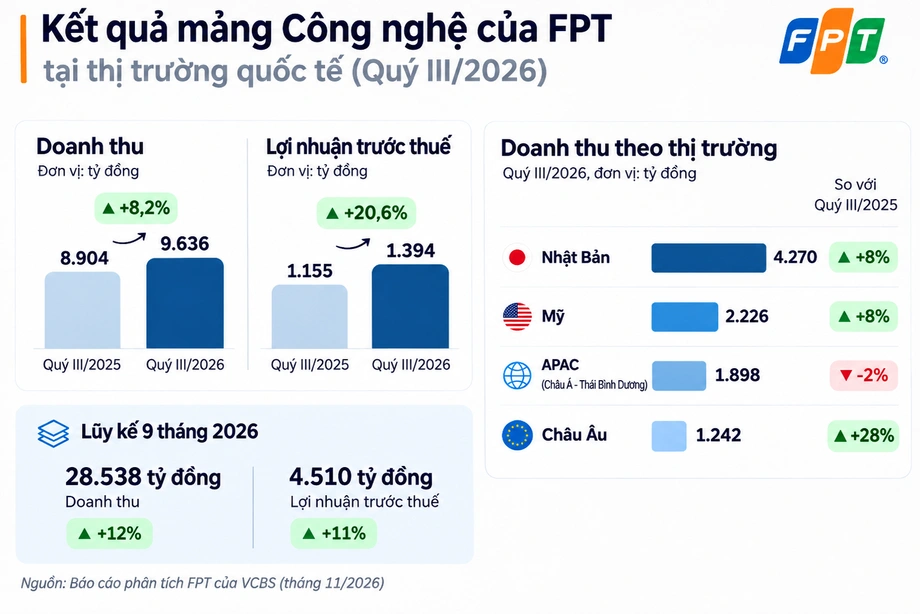
Japan historically served as a primary growth engine for FPT, consistently delivering annual revenue expansions exceeding 20 percent. Recent operational data revealed that revenue growth in the Japanese market moderated to roughly 8 percent during the third quarter, mirroring similar slowdowns in the United States where revenue also grew by 8 percent. Meanwhile, operations in the Asia-Pacific region contracted by 2 percent. Europe emerged as a rare bright spot with a 28 percent revenue increase, yet European operations accounted for only about 10 percent of total overseas technology revenue, making it insufficient to fully offset the moderation observed in larger traditional markets.
FPT management actively pursued business model transformations to adapt to these shifting market conditions. Corporate disclosures highlighted that the firm increased yen-denominated contract prices by an average of about 9 percent across dozens of Japanese clients during 2026, with plans for further adjustments. Leadership also reduced the proportion of time-and-materials contracts in favor of fixed-price agreements and solutions incorporating artificial intelligence applications. Despite cautious short-term forecasts for overseas IT revenue growth, demand for advanced technological services remained active in specialized segments.
Investment in Advanced Technology and Future Growth Drivers
FPT channeled substantial financial resources into artificial intelligence infrastructure to secure new avenues for long-term expansion. The corporation developed two specialized artificial intelligence factories located in Vietnam and Japan, which operated at over 90 percent capacity and generated positive earnings starting in the second quarter of the year. Partnerships with international technology giants such as Nvidia, Microsoft, and OpenAI further strengthened the corporate technical ecosystem. Revenue derived directly from artificial intelligence and data analytics services reached 3.292 trillion dong during the first ten months of 2026, representing a robust increase of more than 50 percent compared to the corresponding period a year earlier.
Financial institutions maintained varied perspectives regarding the valuation and near-term outlook for the stock. Following the prolonged price correction, trading multiples adjusted downward significantly, with the price-to-earnings ratio dropping to levels well below historical medians. While certain advisory firms trimmed their forward profit projections to account for a more cautious environment in international IT services, others maintained positive views based on the company solid balance sheet, double-digit profit increases, and expanding high-tech capabilities.
Timeline of Market Developments and Corporate Actions
- Early 2025: FPT share prices reach historic peak valuations between 115,000 and 120,000 dong per unit.
- Late 2025: Foreign ownership percentage in FPT stands near 39 percent before a sustained period of capital outflow begins.
- October 2026: Institutional tracking reports indicate 27 distinct investment funds engage in net selling of FPT shares.
- November 17, 2026: Share prices decline to 48,500 dong amid broader market indexes dropping below key technical thresholds.
- November 19, 2026: FPT leads all exchange-listed equities in net foreign selling, losing an additional 2.66 percent in trading value.
- November 20, 2026: Consecutive daily declines push the stock price down to 45,000 dong, marking a nearly 60 percent retracement from yearly highs.
- November 27, 2026: Scheduled ex-dividend date for the 2026 interim cash dividend payment of 10 percent.
- December 10, 2026: Anticipated payment date for shareholder cash distributions.
At a Glance
- FPT shares fell to 45,000 dong per unit following five consecutive sessions of price declines.
- Market capitalization contracted to approximately 84.858 trillion dong, reflecting a significant correction from prior peak levels.
- Foreign investors sold a net total of over 18.611 trillion dong in FPT shares across the year up to November 20.
- Ten-month pre-tax profit reached 9.954 trillion dong, marking a 17 percent increase year-over-year.
- Revenue from artificial intelligence and data analytics services expanded by more than 50 percent during the first ten months.
- Foreign ownership in the technology firm decreased from nearly 39 percent at the end of 2025 to approximately 24 percent.