
China Sets Sail with Its Second Homegrown Mega Cruise Ship
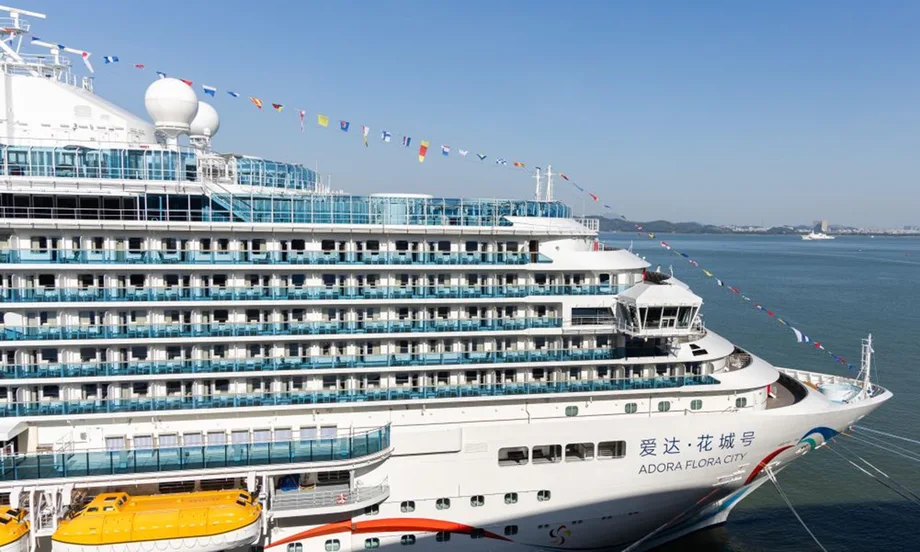
China's second domestically built large cruise ship, Adora Flora City, departed from the Nansha International Cruise Home Port in Guangzhou, South China's Guangdong Province, on November 22, 2026. Carrying more than 3,800 passengers, the vessel embarked on a six-day, five-night maiden commercial voyage to Hong Kong and Hue, Vietnam. This departure marks a new step in the development of China's homegrown cruise industry, moving the nation beyond initial shipbuilding breakthroughs and into regular commercial operations. The ship is larger and more advanced than its predecessor, Adora Magic City, which began commercial operations in January 2024 and has completed about 250 voyages.
目录
Olympic diving champion Guo Jingjing serves as the ship naming ambassador. During the opening night art gala, themed around the flower city and set sail, five Guangzhou performing troupes staged Lingnan cultural showcases, featuring acrobatics, Cantonese opera, puppet shows, and traditional music. Operator Adora Cruises currently manages a fleet of three large vessels, including Adora Magic City, Adora Mediterranea, and Astro Ocean's Gulangyu, serving East, South, and North China alongside Hong Kong under a year-round, multi-home-port model.
Impressive Dimensions and Enhanced Building Efficiency
Adora Flora City measures 341 meters in length and 37.2 meters in width, with a gross tonnage of 141,900. The vessel features 2,130 guest cabins and can accommodate up to 5,232 passengers at full capacity. The wide hull enhances stability, giving the ship stronger resistance to pitching and waves at sea so the ride remains smooth and comfortable even in relatively rough waters. The interior includes 28 restaurants and bars, along with a 200-meter circular athletics track situated on the deck.
Built by Shanghai Waigaoqiao Shipbuilding, a subsidiary of China State Shipbuilding Corp, the ship reached completion significantly faster than the first vessel. Construction required nearly 4 million fewer labor hours than its predecessor and was completed eight months faster. Overall construction efficiency improved by 20 percent compared with the construction of China's first domestically built large cruise ship, and the localization rate of materials used in interior outfitting reached 80 percent. Workers introduced augmented reality technology to superimpose 3D design models onto the actual construction site, allowing mobile devices to compare digital models with physical structures.
Strategic Home Port Operations in Guangzhou
Guangzhou's Nansha International Cruise Home Port is one of the largest cruise port complexes in China, featuring an overall quay length of 770 meters, berths capable of handling vessels up to 22,500 tons, and a 60,000-square-meter terminal building. It is the first cruise port in the country with direct subway connectivity, as a dedicated underground passage from Guangzhou Metro Line 4 opened in November 2026. A duty-free shop at the terminal also opened on the day of the maiden voyage to expand passenger shopping options. Since resuming operations in June 2024, the Nansha port has handled 55 international cruise sailings and 187,000 inbound and outbound passengers.
For the year 2027, Adora Flora City is scheduled to operate more than 50 international voyages from Guangzhou. Itineraries will range from short getaways to longer trips across Southeast Asia, including a series of nine-day, eight-night routes connecting Vietnam, Malaysia, and Brunei. The vessel will also offer several cruises without designated ports of call, giving passengers the option of enjoying onboard facilities and entertainment as part of a sea-based holiday.
Economic Integration and Regional Tourism Impact
Local authorities and industry experts emphasize the broader economic impact of the new vessel on the Guangdong-Hong Kong-Macao Greater Bay Area. Wu Qingsong, deputy director-general of the Guangzhou Municipal Culture, Radio, Television and Tourism Bureau, stated that the maiden voyage offers new opportunities to integrate local resources and cultivate growth points in the cruise economy.
Adora Flora City represents a new stage for China's cruise industry, as it moves from making breakthroughs in shipbuilding toward establishing regular operations and expanding its presence in regional tourism.
Wang Peng, a research fellow at the Beijing Academy of Social Sciences, noted that the expansion of cruise services helps domestic suppliers gain experience and strengthens the industrial chain while supporting the development of Nansha into an international cruise hub serving Southeast Asia. Meanwhile, official data from the Guangzhou Municipal Government highlights that Guangzhou's marine industry production reached 5231 billion yuan in 2025, with plans to surpass 7300 billion yuan by 2030.
Evolution of the Supply Chain and Future Ship Generations
The construction of large cruise ships involves more than 25 million components and thousands of interconnected systems, requiring close collaboration across the supply chain. Adora Flora City has driven the development of about 1,500 suppliers across the industrial chain, encompassing both domestic and international partners. Chen Gang, chairperson of Shanghai Waigaoqiao Shipbuilding, explained that China has made progress in establishing its own cruise research and development system, verifying key technologies, and developing standardized production design processes.
China is following a strategy of building one generation of ships while designing the next and researching a subsequent generation. Preliminary conceptual design work on the country's third domestically built large cruise ship has already begun. Li Jianing, assistant general manager of Shanghai Waigaoqiao Shipbuilding, emphasized that delivering two domestically built cruise ships is not simply a matter of repeating a project, but represents a systematic effort to strengthen national capabilities in cruise shipbuilding.
At a Glance
- Adora Flora City is China's second domestically built large cruise ship, measuring 341 meters in length with a gross tonnage of 141,900.
- The ship departed from Guangzhou on November 22, 2026, carrying over 3,800 passengers on its maiden voyage to Hong Kong and Hue, Vietnam.
- The vessel features 2,130 cabins, a maximum capacity of 5,232 guests, 28 restaurants and bars, and a 200-meter circular athletics track.
- In 2027, the ship will operate more than 50 international voyages from Guangzhou, including routes to Vietnam, Malaysia, and Brunei.
- Construction efficiency improved by 20 percent compared to the first domestically built cruise ship, with interior outfitting achieving an 80 percent localization rate.